
Why The First Six Years Matter More Than The Next Sixteen
- 3 days ago
- 5 min read
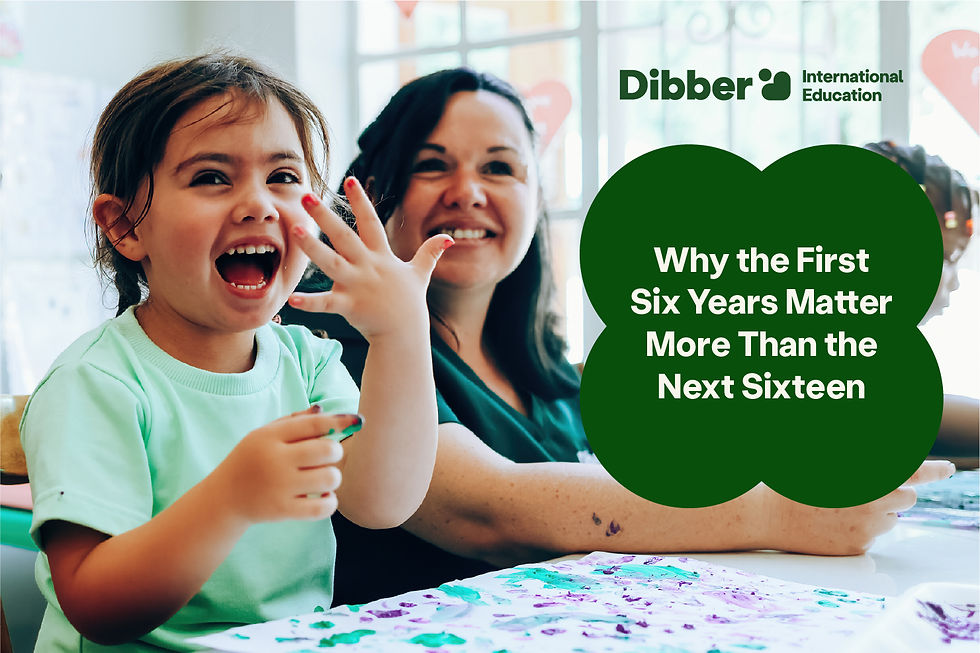
The routines, the environments, the quality of care, the words spoken in passing; do they truly shape who a child becomes, or is ‘development’ something that largely takes care of itself?
The answer, drawn from decades of research in neuroscience, psychology, and education, is very clear. Early childhood development is not one chapter among many in a child's life. It is “the chapter” that determines how all the others are read and understood. The experiences, relationships, and environments a child encounters in their first six years do not simply influence who they become. They construct the very architecture of the person they will be.
And it begins with understanding what is actually happening inside a young child, and why it matters so much.
A Window That Will Not Stay Open Forever
The human brain grows faster in the first five years of life than at any other point in a person's existence. By the time a child starts primary school, roughly 90 percent of the brain's structural development is already complete. This is not a rough estimate. It is one of the most well-established findings in developmental neuroscience.
What this means is that the period we sometimes treat as preparatory (the early years before formal schooling begins) is in fact the most neurologically intensive period of human life. The connections being formed right now, between birth and age six, are the ones that will underpin language, reasoning, emotional regulation, creativity, and social intelligence for decades to come and for as long as each of us will live.
Researchers describe this as a sensitive period in early childhood development: a window of heightened ‘neurological plasticity’ during which the brain is exceptionally responsive to experience. The brain remains capable of change throughout life. But it will never again be quite this open, quite this ready, quite this hungry for input.
At Dibber South Africa, our Nordic-inspired approach is built around a deep respect for this developmental window. Every interaction, every space, every educator relationship is designed with the understanding that what happens now has a long reach.
How Stress Shapes A Developing Brain
Brain development in the early years is not simply about accumulating skills and knowledge. It is also about learning to feel safe in the world, and that lesson is written directly into the nervous system.
When young children experience chronic stress - whether through instability, harsh environments, emotional unpredictability, or simply being consistently overwhelmed - the brain responds by prioritizing threat detection over having fun and exploring.
Cortisol, the body's primary stress hormone, can actually interfere with the formation of neural connections in areas associated with learning, memory, and emotional regulation.
The inverse is equally true. Children who experience consistent warmth, responsive caregiving, and emotionally safe environments develop nervous systems that are genuinely better equipped for curiosity, focus, and resilience.
Safety and emotional security, in the context of early childhood development, is not a precondition for learning. It is learning in its most foundational form.
Secure attachment with a trusted adult is the single most protective factor in early childhood.
Predictable routines reduce background stress and free the brain for exploration and creativity.
Emotionally available caregiving builds the neural pathways that underpin lifelong self-regulation.
The Skills That Cannot Be Downloaded Later
There is a persistent assumption in education that skills deferred are skills merely delayed. That, what a child does not learn now, can simply be taught effectively later.
For some things, this is true. For others, the window for optimal development is genuinely narrower than we might hope.
Language acquisition is the most well-documented example. The brain's capacity to absorb language effortlessly - including pronunciation, grammar, and the intuitive feel of a mother tongue - peaks dramatically in the first three years of life and begins to narrow by age seven.
Children who grow up in language-rich environments during this period develop a relationship with communication that is qualitatively different from those who do not.
The same principle applies, in varying degrees, to real-life skills as well. Like a cluster of skills that include focus, impulse control, and cognitive flexibility, for example. Even those like empathy, social understanding, and a positive sense of self. These capacities are not impossible to build later. But the scaffolding laid down during early childhood development makes everything that follows easier.
Our play-based curriculum, at Dibber International Education, is intentionally designed to nurture language, real-world skills, and emotional intelligence in the years when the brain is most ready to receive them, not just as a series of structured lessons, but woven through every interaction and experience of the day.
What Does Good Early Childhood Development Actually Look Like?
Given the weight of what is happening in the early years, one might expect optimal early childhood development to look intensive - structured, scheduled, rigorous. The evidence, on the contrary, points elsewhere.
The environments and experiences most strongly associated with positive developmental outcomes in young children tend to share a handful of qualities:
Warm, consistent relationships with a small group of trusted adults who genuinely know each child.
Rich opportunities for child-led, open-ended play - the primary mechanism through which young children process and make meaning of the world.
Language-rich environments where adults talk with children and treat their questions as worthy of real answers.
Physical spaces that are calm, ordered, and designed to invite exploration rather than overwhelm and overstimulate the senses.
Room to fail, to try again, and to experience the quiet pride of working something out independently and believe “I Can!”
None of these require expensive materials or elaborate programs. They require something harder and more valuable: adults who understand what children actually need, and the commitment to provide it consistently.
The first six years is not the whole story of a child. Growth continues, beautifully and significantly, well beyond those years. But early childhood development lays out something that cannot be fully replicated: the original, deep structure of how a person thinks, feels, relates, communicates, and learns.
Tending to it well is not a luxury reserved for particular kinds of families or particular kinds of schools. It is the most important investment any of us will ever make in a child's future, and it begins in the ordinary moments of every ordinary day.
Dibber South Africa offers Nordic-inspired early childhood education across Johannesburg, Pretoria, and Cape Town for young children from 6 weeks to 6 years. Visit dibber.co.za to learn more or to book a visit to a preschool of your preference.


Comments