
The Role Of Calm Environments In A Child's Development
- Apr 16
- 4 min read
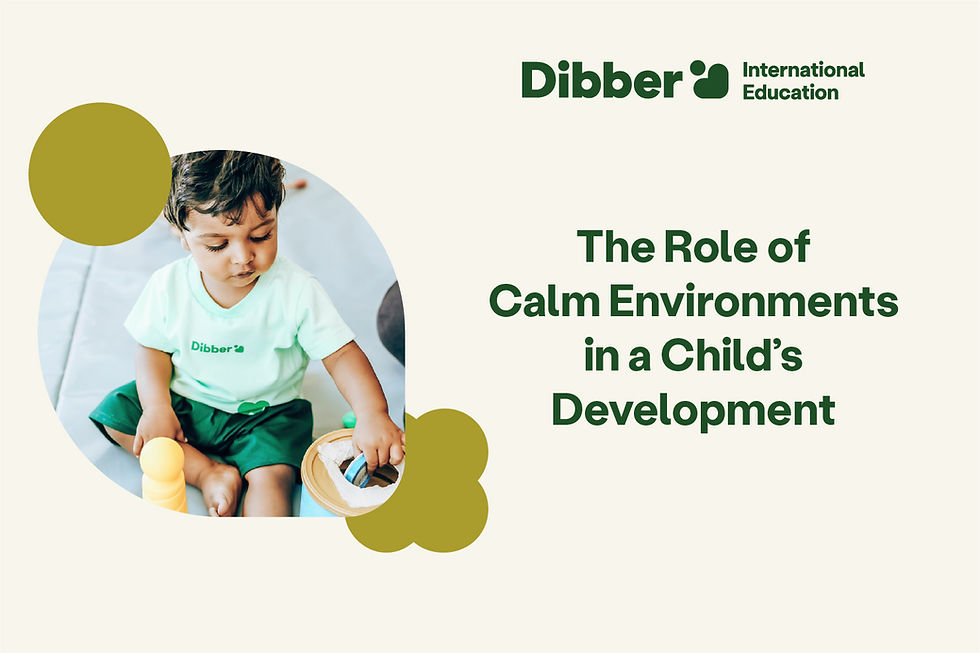
Walk into a calm room and something in you settles. Your shoulders drop. Your breathing slows. Your thoughts find space. Now imagine experiencing that shift for the very first time, as a two-year-old, before you have the language to describe it, before you even know what calm feels like yet.
The world is stimulating enough. Our job (as parents, caregivers, and educators) is to make sure that when a child needs to land, there is always somewhere soft to land.
The environments we create for young children do far more than keep them safe. They shape how children feel about themselves, how willing they are to explore, how quickly they recover when things go wrong, and how deeply they can learn. A calm environment for children is not a luxury or an afterthought. It is one of the most powerful developmental tools any parent, caregiver, or educator should resort to.
Why Calm Matters More Than We Realize
Young children are not miniature adults. Their nervous systems are still developing, which means they are extremely sensitive to the sensory and emotional tone of the spaces around them. Noise, visual clutter, unpredictability, and emotional tension are not just uncomfortable; they are genuinely taxing for a young, developing brain that is trying to make sense of the world around them.
When a child's environment is overwhelming, the brain shifts into a state of alertness, prioritizing survival and self-protection over curiosity and connection. In this state, deep learning is simply not possible. The brain is too busy managing the environment to explore it.
A calm environment for children does the opposite. It tells a young nervous system: you are safe here. You can relax. You can wonder. And in that state of safety and security, remarkable things begin to happen to them.
At Dibber South Africa, our classrooms are purposefully designed, not just decorated. Every corner, material, and layout choice is made with one question in mind: does this help each child feel completely at home and at ease?
What Does A Calm Environment Actually Look Like At Preschools?
“Calm” does not mean “silent”. It does not mean sterile, rigid, or without joy. In fact, the most nurturing early childhood spaces are often full of gentle movement, soft conversation, and purposeful activities. What they share is an intentional quality - a sense that every element of the space has been thoughtfully considered and designed.
In practice, a calm environment for young children typically includes:
Natural materials and soft textures that invite touch without overwhelming the senses.
Predictable routines that give children a sense of order and agency throughout the day.
Soft, warm lighting rather than harsh overhead fluorescents.
Clearly defined spaces, areas for quiet play, active exploration, and rest, so children always know where they are and what is possible.
Engaged EducatorsTM and support staff who regulate their own tone and energy, modelling calm as a lived practice rather than an instruction.
This kind of intentional design is not incidental to early childhood education; it ‘is’ early childhood education.
4 Developmental Benefits That Follow
When young children spend their days in calm, well-considered environments, the effects ripple across every area of development, namely:
Emotional Security & Regulation
Children who feel consistently calm in their environment begin to internalize that calm. Over time, they develop the capacity to self-regulate - to manage big feelings, recover from disappointment, and return to a settled state quickly. This is one of the most transferable life skills any child can develop.
Deeper Focus & Concentration
A child who is not managing environmental stress is free to give their full attention to what is in front of them. Sustained focus, even in short bursts at earlier years of their lives, is the foundation of all future learning, from reading to problem-solving to creative thinking.
Confidence & Willingness To Try
Children often take more developmentally appropriate risks when they feel safe and cared for. A calm environment communicates that it is okay to attempt something difficult, to make a mess, to not know the answer. That quiet permission is transformative.
Stronger Relationships With Educators & Peers
During our younger days, individuals are far more available for genuine connections. Friendships form more naturally. Trust in educators deepens. And with that trust comes an openness to being guided, supported, and gently challenged.
It Matters At Home Too
Calm environments matter beyond the classroom. As a parent, even minor shifts – a consistent bedtime routine, a designated corner for quiet play, lowering your own voice during transitions and stressful periods - can meaningfully support your child's sense of security and emotional wellbeing.
Calm As A Philosophy, Not Just A Setting
At Dibber International Education in South Africa, our approach to calm environments is rooted in Nordic pedagogy, a philosophy that has understood for decades what research is now confirming: that how a child feels in their environment directly determines what they are able to learn from it.
Our Engaged EducatorsTM are trained not only to design and maintain calm physical spaces, but to bring emotional calm themselves; to be the steady, warm presence that a young child can walk towards confidently when the world feels too big and overwhelming for them.
Because ultimately, the calmest environment a child can experience is a person who is genuinely present with and for them. A space that is beautiful but cold will not settle a child. A space that may be imperfect but held by someone who truly sees that child? That will.
We offer Nordic-inspired early childhood education in our 600+ preschools and schools across 9 countries. Visit dibber.co.za to learn more or to book a visit to one of our 17+ preschools across Johannesburg, Pretoria, and Cape Town.


Comments